Key Takeaways
- A roof, its gutters, its downspouts and the ground below them are one water management system. A weakness anywhere along that path shows up somewhere else.
- A roof surface in good condition can still send water where it should not go if the gutters, downspouts or drainage area are not doing their part.
- Valleys and flashing transitions carry more water, and more risk, than the open roof surface around them.
- The signal worth acting on is repetition: the same damp spot, the same stain or the same puddle, storm after storm.
- HOMEMASTERS Portland SW serves Tualatin, Tigard, Sherwood, Raleigh Hills and Lake Oswego. Reach the branch directly at (503) 345-7733.
HOMEMASTERS Portland SW | CertainTeed ShingleMaster certified | (503) 345-7733
You think about rain constantly in Tualatin. Yet the roof, the gutters and the drainage below them still tend to get treated as three separate topics.
They are one system with one job: move water off the house and away from it. HOMEMASTERS Portland SW, the Tigard based roofing and gutter branch serving Tualatin at (503) 345-7733, evaluates them that way, because when any part of that path is compromised, the rest of the system inherits the problem, whichever part gets blamed for it.
Why Is Late September the Right Time to Look at Roof Drainage in Tualatin?
Because the wet season west of the Cascades usually settles in during October and runs well into spring, and a drainage system is far easier and cheaper to keep working before it is under daily load. This is a maintenance conversation, not a damage conversation. Nothing has to be wrong for the timing to be right.
Tualatin shares the sustained, rather than intense, rainfall of the wider Portland metro area, so roofs manage water for months at a stretch. Under the mature canopy of established neighborhoods in Tualatin, Tigard and Raleigh Hills, the system also handles needles, leaves and moss debris all season.
What Do Most Homeowners Misunderstand About Roof Drainage?
The most common gap is treating the roof, the gutters and the drainage area as independent systems, each judged on its own. Water does not recognize those boundaries.
The second is assuming that a roof surface that looks fine means the whole system is fine. A sound roof can still send water where it should not go if the gutters or downspouts are failing, and good drainage cannot compensate for a roof problem upstream. The path water actually takes tells the whole story.
How Does Water Actually Travel From Your Roof to the Ground?
In one continuous path: across the roof surface, through the valleys and past the flashing, into the gutters, down the downspouts and out into the drainage area. A failure at any stage becomes a problem at the stage after it.
The roof surface. Collection starts here. Water should shed toward the edges along the slope without pooling. Asphalt shingles rely on overlapping courses and an adhesive seal strip, and debris that holds water against those courses works against that seal.
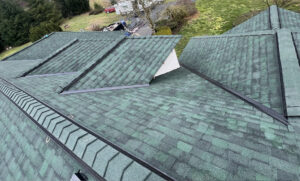
Valleys. Where two roof planes meet, more water passes than almost anywhere else on the roof, so anything obstructing a valley has an outsized effect on everything downstream.
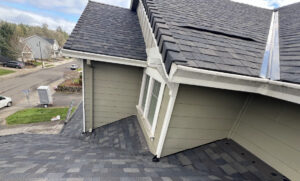
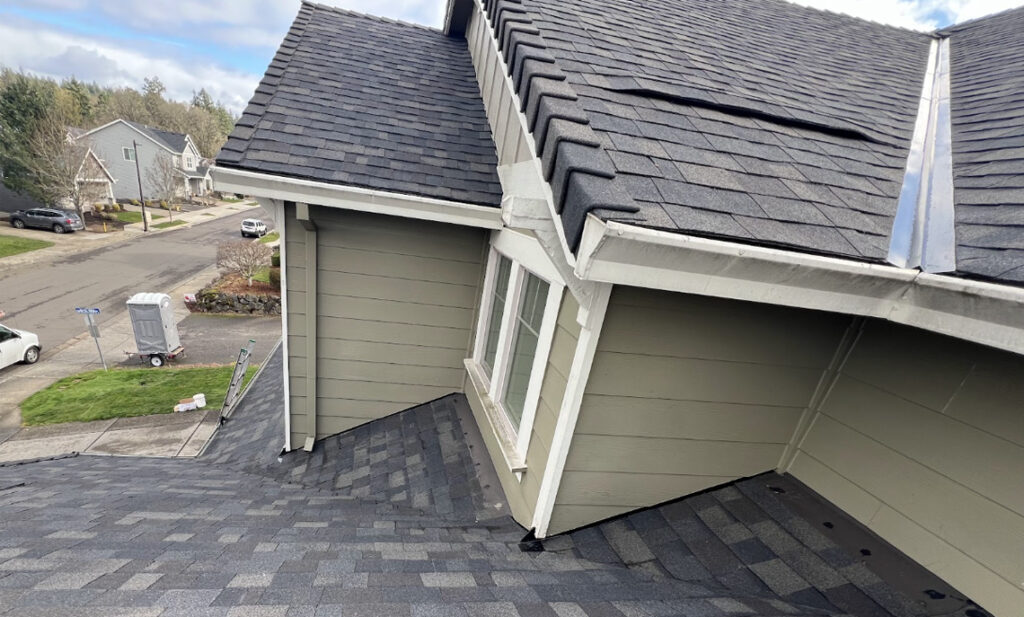
Flashing. Around chimneys, sidewalls and roof transitions, the roof meets something else. These are the most common places for water to find a path it is not supposed to take, which is why flashing condition matters as much as the open field of shingles.
Gutters. The roof’s catch basin. Their job depends entirely on being clear and correctly pitched toward the downspouts. A gutter that has sagged or lost its pitch holds standing water even when it is clean.
Debris and overflow. Under a mature canopy, debris is a normal maintenance item, not a failure. Left long enough, it causes overflow, which sends water over the front edge or behind the gutter onto the fascia and siding.
Downspout discharge. The handoff to the ground. A downspout that empties against the foundation, or that has come loose from its drain connection, can undo the work of an otherwise healthy roof and gutter system.
The drainage area. A storm drain connection, a dry well or ground graded to carry water away from the house. This is where the system either finishes its job or does not.
Moss. Common west of the Cascades and not a problem by itself. It is worth treating when it holds moisture against the shingles, when its rhizoids lift shingle edges, or when it sheds into valleys and gutters. Zinc sulfate is the usual treatment. Pressure washing is not, because it strips granules.
Not sure where the water on your Tualatin roof is actually going? Call HOMEMASTERS Portland SW at (503) 345-7733, or visit the Portland SW location page, to schedule a roof and gutter check.
Which Warning Sign Deserves the Most Attention?
Repetition. Water concentrating at the same location, storm after storm, is the clearest sign it has found a consistent path it should not take. A single wet day means little. The same damp fascia board, the same stain on the siding, or the same corner of the yard puddling every season deserves a closer look.
What Should You Check on Your Own Home?
- When were my gutters last cleared, and by whom?
- Are there spots, inside or outside, where I notice moisture more than once a season?
- Do my downspouts empty somewhere that carries water away from the foundation?
- Have I ever followed water from the roof all the way to where it ends up?
A professional drainage check should then answer where water enters and exits the system, whether the gutters and downspouts are sized for the roof area they serve, and whether any recurring damp spot traces to one specific point.
Why Is Roof Maintenance in Tualatin an Ongoing Relationship?
A roof rarely fails because of one bad month of rain. It fails from an accumulation of small, unaddressed gaps: a clogged valley here, a misaimed downspout there. That makes roof care here an ongoing relationship, not a single inspection.
HOMEMASTERS Portland SW handles roofing and seamless on site aluminium gutters with crews who are W-2 employees rather than subcontractors, so the team that evaluates the roof also evaluates where its water goes. The same whole system approach is standard across the network, including at HOMEMASTERS Portland East.
Frequently Asked Questions
Under a mature tree canopy, most homes benefit from clearing at least once in late fall after leaf drop, and many need a second pass in spring. Homes under conifers may need attention more often because needles shed year round. Call HOMEMASTERS Portland SW at (503) 345-7733 to talk through a schedule.
Not by itself. Moss becomes a concern when it holds moisture against the shingles, lifts shingle edges or sheds into gutters. Treatment is usually zinc sulfate, not pressure washing.
Usually because of lost pitch, an undersized or partly blocked downspout, or a valley delivering more water to one section than the gutter can carry. Each has a different fix. Call (503) 345-7733 to have it checked.
Somewhere that carries water away from the foundation, such as a working storm drain connection, a dry well or ground graded away from the house. A downspout emptying against the foundation can undo the work of a healthy roof and gutter system.
Ready to get ahead of the wet season in Tualatin? Call HOMEMASTERS Portland SW at (503) 345-7733 or visit the Portland SW location page to schedule a roof, gutter and drainage check.