Key Takeaways
- Most of what homeowners see on a roof fits one of three categories: routine maintenance, worth monitoring, or worth evaluating. Knowing which makes the next step clear.
- Moss signals a section that stays damp. It becomes a concern when it thickens enough to lift shingle edges or hold water against the roof.
- Black streaks are usually algae and largely cosmetic. Bare patches where granules have worn away are a different matter.
- A clean gutter can still overflow if it is undersized, mis-sloped or fed by a blocked downspout.
- Never pressure wash a roof. HOMEMASTERS has eight branches across Oregon, Southwest Washington and Idaho, and every branch number is listed at the end of this article.
HOMEMASTERS | Eight branches across Oregon, Southwest Washington and Idaho | W-2 employee crews | Find your branch
Moss on the north side of the roof. Pine needles packed into a valley. Water spilling over a gutter in a downpour. They look like three different problems, but they lead to the same question: is this maintenance, or is something happening to my roof?
It depends on the condition. HOMEMASTERS, the roofing and exterior company with eight branches across Oregon, Southwest Washington and the Boise area of Idaho, sorts these observations the same way everywhere: by what the condition is doing to the roof.
How Should You Sort What You See on Your Roof?
Into one of three categories. Most start in the first; the goal is to notice when one moves into the next.
Routine maintenance. The condition sits on the surface and cleaning or clearing will address it. Light debris, a clogged gutter or early moss usually belong here.
Worth monitoring. Nothing is clearly wrong yet, but it could change. Spreading moss, recurring gutter overflow or debris that returns quickly to the same spot are worth photographing and watching.
Worth evaluating. The condition may be affecting how the roof sheds water, or there are signs of moisture getting in. Lifted shingles, indoor stains or damaged flashing near a debris buildup belong here.
Does the Same Condition Mean the Same Thing Everywhere?
No. The same observation means different things in different climates, so a visible symptom is a reason to interpret, not to conclude.
West of the Cascades. Around Portland, Vancouver, Salem and Eugene, and along the southern Oregon coast, long wet seasons and mature tree cover create what moss needs: shade, moisture and organic debris that holds water against the roof.
Central and Southern Oregon interiors. Around Bend and in the Rogue Valley, pine needles, dry debris after fire season, snow and ice at the roof edges and strong seasonal sun are more common concerns than moss.
The Boise area. In the semi arid Treasure Valley, moss is less common; tree debris and winter ice at the eaves are the usual watch points.
What Do Homeowners Misunderstand About Moss, Streaks and Gutters?
Moss does not automatically mean the roof is failing. It means a section stays damp long enough to support growth. Early on, it is usually a maintenance issue. The concern grows when moss thickens enough to lift shingle edges or hold moisture against the roof for long stretches.
Dark streaks are not necessarily damage. The black or gray streaks common on Northwest roofs are often algae, which is largely cosmetic. Bare patches where granules have worn away can indicate aging. From the ground the two can be hard to tell apart, and many newer shingles carry copper granules to resist algae.
Clean gutters do not guarantee good drainage. A gutter can be clear and still overflow if it is undersized, sloped incorrectly or fed by a downspout blocked below grade.
Not sure which category your roof falls into? Find your nearest branch on the HOMEMASTERS locations page and call to have the condition looked at.
How Do Moss, Needles and Debris Actually Affect a Roof?
By slowing water where the roof needs it to move fastest. Where a condition sits matters more than how much there is.
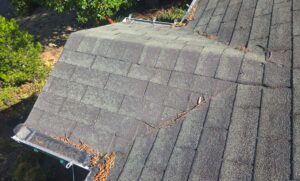
Moss and shade. North facing and shaded slopes dry slowly. Moss establishes along shingle edges and seams, and as it thickens it can lift edges and slow water. A thin layer and a mat that raises shingles are very different situations.
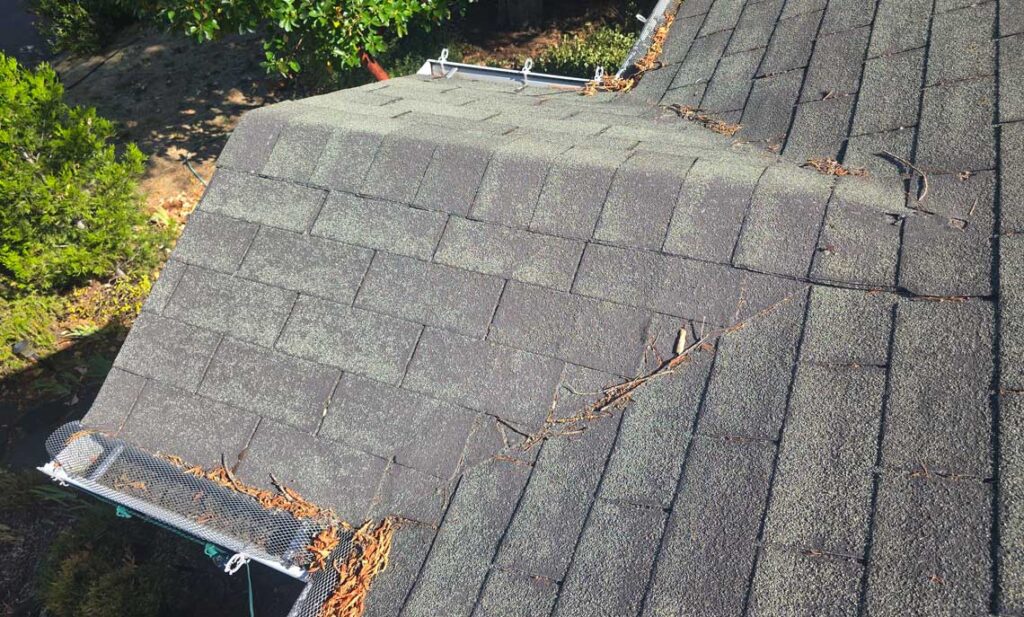
Needles and debris. Valleys carry a large share of the roof’s water, and chimneys and walls interrupt the flow. Pine needles knit into dense mats that drain poorly and work into gaps around flashing.
Transitions. Valleys, chimney and wall intersections, skylights and vent pipes rely on flashing to direct water. When debris or moss collects at a transition, the flashing does extra work, and that is where a surface condition most often becomes a moisture concern.
How Can You Tell a Surface Condition From Real Damage?
A surface condition sits on top of the roof; removing it may be all that is needed. Underlying damage involves the materials or structure beneath. If you see any of these alongside moss or debris, get an evaluation rather than only cleaning:
- Shingles that are lifted, cracked, curled or missing in the affected area.
- Flashing that looks bent, rusted or separated.
- Water stains on ceilings or walls, especially near valleys or chimneys.
- Musty odors or visible moisture in the attic, or sagging areas on the roof.
Cleaning removes the symptom, not what is underneath.
What Should You Avoid When Cleaning a Roof?
Pressure washing. It strips protective granules, forces water under roofing materials and shortens roof life.
Aggressive scraping. Hard tools damage shingle surfaces and edges, especially on brittle roofs.
Walking on wet or mossy roofs. Moss and wet debris are extremely slippery, and foot traffic can damage some materials.
Improvised chemical mixes. Some can harm plants, stain siding or run into storm drains. Use any product only as its label directs.
From the ground you can safely observe and photograph changes. Leave steep or high work to professionals.
When Does Professional Help Make Sense?
When moss covers a meaningful part of the roof or keeps returning, a trained crew can remove it without damaging shingles. When gutters overflow even after cleaning or downspouts discharge near the foundation, drainage correction is the step. And when there are indoor stains, visible shingle or flashing damage, attic moisture, or real uncertainty, a roof inspection answers the question that cleaning cannot.
HOMEMASTERS crews are W-2 employees rather than subcontractors, and they approach these observations like any roofing question: look at the actual condition, explain it, then recommend cleaning, monitoring or repair.
Frequently Asked Questions
Not by itself. Moss signals a section that stays damp. It becomes a concern when it thickens enough to lift shingle edges or hold moisture against the roof, and it should be removed without pressure washing.
Usually not. Black or gray streaks are most often algae, which is largely cosmetic. Bare patches where granules have worn away are different and can indicate aging, so have them looked at if you are unsure.
A clean gutter can still overflow if it is undersized, sloped incorrectly or fed by a downspout that is blocked below grade. Each has a different fix, so it is worth identifying which applies.
No. Pressure washing strips protective granules, forces water under roofing materials and shortens roof life. Moss should be removed by gentle methods and treatments used as their labels direct.
Seeing moss, needles or overflowing gutters and want a straight answer? Call your nearest HOMEMASTERS branch: Portland SW (503) 345-7733; Portland East (503) 766-3912; Vancouver (360) 836-4100; Salem (503) 917-3651; Eugene (541) 204-4462; Bend (541) 527-7002; Southern Oregon (541) 240-8977; Boise (208) 361-0068. Or contact HOMEMASTERS online. There is no pressure to buy work you do not need.