Key Takeaways
A low slope commercial roof fails differently from a residential one. Water does not run off it, it sits on it, so drainage and seam integrity matter more than material choice.
Ponding water is the single most useful diagnostic on a flat roof. Water still standing 48 hours after rain indicates a drainage or deflection problem, not simply a wet roof.
On a multi-family property the roof is rarely just a roof. Tenant occupancy, phased scheduling, access, and the cost of a single interior claim change the entire calculation.
September is the last dependable dry stretch in the Rogue Valley before the wet season, and membrane work needs dry substrate and warm adhesive conditions.
HOMEMASTERS Southern Oregon serves Grants Pass, Cave Junction, Selma and the Applegate Valley. Free written estimates. Call (541) 240-8977.
Talk to [HOMEMASTERS Southern Oregon, Oregon CCB licensed, bonded and insured, Owens Corning Platinum Preferred and GAF certified, with W-2 employee crews rather than subcontractors. Call (541) 240-8977.
Most roofing advice written for property owners is really residential advice with the word commercial pasted on top. That is a problem, because the failure modes are not the same. A steep residential roof sheds water in seconds. A low slope commercial roof holds it, and everything that goes wrong on one follows from that single fact.
If you own or manage a building, an apartment block or a small commercial property in Grants Pass or Josephine County, here is what actually determines whether your roof gets through this winter.
What is different about a commercial roof?
Commercial roofs are typically low slope, which means water drains slowly rather than running off. That makes drainage design, seam integrity, flashing at penetrations and parapet detail far more important than on a residential roof, and it means small defects have time to become leaks. Membrane systems, drains and scuppers, and rooftop equipment curbs are the components that most often fail.
The five things to check on a low slope roof
1. Ponding water
Walk the roof after rain. Water still standing 48 hours later is the clearest signal you will get. Ponding adds weight, accelerates membrane degradation, magnifies ultraviolet damage in the Rogue Valley sun, and marks the low spot where the next leak will appear. The cause is usually a blocked drain, an undersized drain, or deck deflection between joists.
2. Drains, scuppers and overflow
Every drain should be clear and strainers should be in place. Conifer needles and cottonwood litter are the usual culprits here, and they collect fastest in late summer. Confirm the building has functioning overflow provision, because a fully blocked primary drain on a flat roof with parapets turns the roof into a shallow tank.
3. Seams and flashing
Membrane roofs fail at joints, not in the field. Check seams for lifting or open edges, check the base flashing where the membrane turns up a parapet or wall, and check the termination bar at the top of that turn. On older properties, seams that were heat welded well will still be sound while sealant applied later has failed.
4. Rooftop equipment
Every unit, duct, conduit run and vent penetration is a hole in the roof with a detail wrapped around it. Curbs, pitch pans and pipe boots deteriorate faster than the membrane around them. Damage from foot traffic during equipment servicing is one of the most common causes of leaks on a commercial roof, and it usually appears near the units rather than at the perimeter.
5. The parapet and the coping
Parapets take weather on both faces. Failed coping joints let water into the wall assembly, which shows up inside as damage that looks like a roof leak but is not on the roof at all. This is a frequent misdiagnosis and an expensive one.
Need a written condition report on a commercial or multi-family roof? Call HOMEMASTERS Southern Oregon at (541) 240-8977 for a free written estimate with no pressure and no obligation. See the full commercial roofing scope or the Southern Oregon location page
What Rogue Valley conditions do to a commercial roof
Southern Oregon is harder on membrane roofing than the west side of the state, for reasons that have nothing to do with rain.
Ultraviolet exposure is the dominant ageing mechanism. Long hot summers with intense sun degrade exposed membrane, and a reflective surface that has been allowed to accumulate grime loses much of its benefit. Reflective membranes also reduce cooling load, which matters on a building with rooftop units running through a Rogue Valley August.
Thermal cycling opens joints. Large daily temperature swings expand and contract every metal component, working on coping joints, termination bars and fastener plates over a season.
Wildland interface risk applies to commercial property too. Josephine County contains high hazard zones, and debris on a flat roof or in a parapet corner is the same ember catch it would be on a house. Keeping the roof and drains clear is a fire item as much as a drainage one.
Multi-family, and why occupancy changes everything
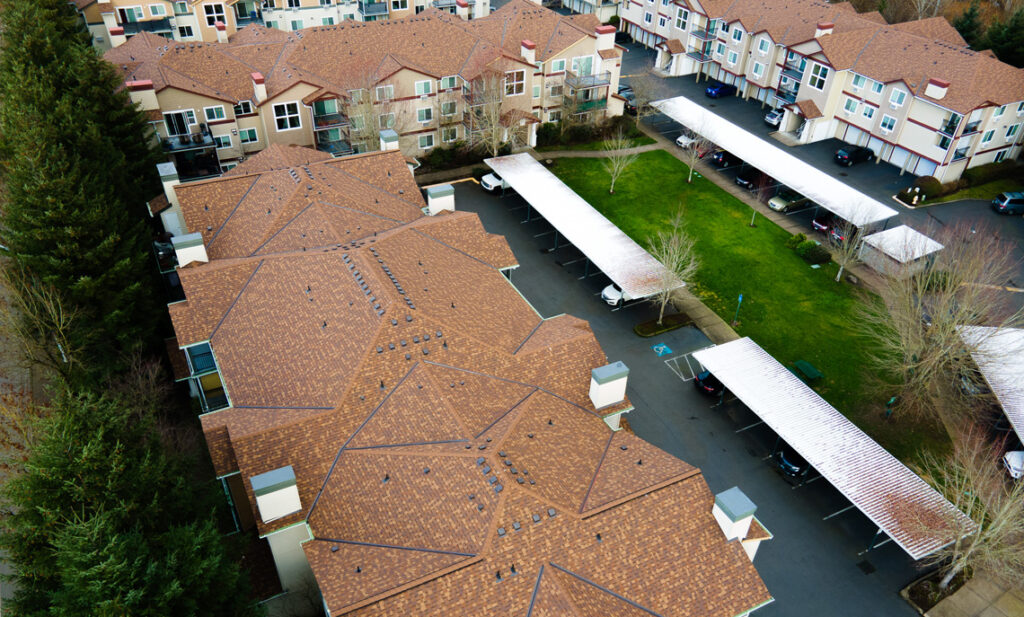
On an occupied apartment or condominium property the roof project is really a logistics project. Work has to be phased so that no section is left open overnight, tenant notification and parking are real constraints, staging has to keep walkways clear, and debris control matters more when residents are walking underneath.
The financial calculation changes too. A single leak that damages a top floor unit means remediation, possible relocation, lost rent and a claim, and that figure frequently exceeds the cost of the roof section that failed. Owners who have been through one rarely defer the next.
For properties in a homeowner association or with multiple buildings, the practical approach is a single condition survey across all roofs, a ranked replacement order, and a written multi year plan rather than reacting building by building.
What it costs
Commercial roofing is priced by system, square footage, deck condition, insulation and detail count, and it does not fit the residential ranges published elsewhere on this site. Rather than quote a figure that will not apply to your building, the honest answer is that a written scope after a physical survey is the only number worth having, and it is free. Ask any contractor to itemize tear off, deck repair, insulation and cover board, membrane type and thickness, flashing detail, drain work and warranty term, then compare those lines rather than the totals.
For reference, a full residential [roof replacement](https://homemasters.com/services/roofing/) in this service area runs $9,500 to $22,000, but that framework does not transfer to commercial work and should not be used to estimate it.
Frequently Asked Questions
Walk it after rain and look for ponding water still standing 48 hours later, lifted or open seams, failed flashing where the membrane turns up a parapet, and damage around rooftop equipment. Recurring leaks in the same area after repeated repairs usually indicate a system at end of life rather than a repairable defect. Call HOMEMASTERS Southern Oregon at (541) 240-8977 for a written condition report.
Standing water adds weight to the deck, accelerates membrane breakdown, magnifies ultraviolet damage and marks the low point where the next failure will occur. It also indicates the underlying cause, which is usually a blocked or undersized drain or deck deflection. Ponding is a warning rather than a leak, which is exactly why it is worth acting on.
Yes, and it is done routinely. The work is phased so no section is left open overnight, tenants are notified in advance, staging keeps walkways and parking clear, and debris is controlled at ground level. Phasing extends the schedule but avoids relocation and keeps the property in service.
It depends on system type, square footage, deck and insulation condition and the number of penetrations and details, so the residential ranges published elsewhere do not apply. A written scope following a physical survey is the only reliable figure, and it is provided free. Call (541) 240-8977 to arrange one.
Late summer through early autumn. Membrane systems need a dry substrate and warm conditions for adhesives and welds, and the Rogue Valley wet season closes that window. Scheduling now also puts the project ahead of the first storm calls.
Get a free written commercial roof assessment in Grants Pass HOMEMASTERS Southern Oregon provides free written estimates with no obligation across Grants Pass, Cave Junction, Selma and the Applegate Valley. Call (541) 240-8977 or visit the Southern Oregon location page to request a survey.