Key Takeaways
- Inadequate attic ventilation allows attic temperatures to reach 150 to 180 degrees in Rogue Valley summers cooking shingles from below and accelerating granule loss, oxidation, and cracking faster than even Southern Oregon’s intense UV exposure alone causes.
- A roof system that looks fine from outside can be losing years of service life due to undetected ventilation deficiencies that most homeowners are unaware of.
- The IBC requires a minimum ventilation ratio of 1:150 split evenly between soffit intake and ridge exhaust. Many older Rogue Valley homes do not meet this standard.
- Addressing ventilation during a roof replacement is the most cost-effective approach because ridge and soffit vent installation is significantly less disruptive and less expensive when the roof is already being worked on.
- HOMEMASTERS Southern Oregon serves Medford, Ashland, Grants Pass, Jacksonville, Central Point, Talent, Phoenix, Eagle Point, Applegate, Shady Cove, Gold Hill, Rogue River, and Cave Junction | Call (541) 240-8977 for a free ventilation and roofing assessment.
HOMEMASTERS Southern Oregon provides roofing inspections that include full ventilation assessment throughout the Rogue Valley. Call (541) 240-8977.
Most Rogue Valley homeowners who are watching their roofs age faster than expected are focused on the obvious culprits: the intense Southern Oregon sun, the thermal cycling between summer highs above 100 degrees and winter cold snaps, the occasional hail event. These are all real contributors to accelerated roofing wear.
What those homeowners are less likely to suspect is what is happening on the other side of the shingles: inside the attic. In a poorly ventilated attic during a Medford July, the air temperature can reach 160 to 180 degrees Fahrenheit. That superheated air is pressed against the underside of the roof deck, conducting heat directly into the shingles above it. The shingles are being degraded simultaneously from above by UV and from below by heat, and the heat damage from below is completely invisible until the shingles start curling and cracking ahead of schedule.
The Physics of Attic Heat and Shingle Degradation
How Attics Become Heat Engines in Summer
When solar radiation heats your roof surface, the energy conducts through the shingles and deck into the attic space below. In a well-ventilated attic, outdoor air flowing in through soffit vents and out through ridge vents carries this heat out of the attic continuously, keeping attic temperature within 10 to 20 degrees of outdoor ambient. In a poorly ventilated attic, this heat has nowhere to go. It accumulates through the day, and by afternoon a Southern Oregon attic can reach 160 degrees when outdoor temperature is 95 degrees.
What 160 Degrees Does to Asphalt Shingles
Asphalt shingles are engineered to manage a range of temperatures, but sustained exposure to 150 to 180 degrees from below accelerates two destructive processes. First, the asphalt binder softens and flows slightly, causing granules to loosen and shed faster than UV exposure alone would cause. Second, the repeated thermal cycling between extreme heat and overnight cooling drives expansion and contraction cycles in the shingle material that eventually leads to cracking and splitting at stress points.
According to the National Roofing Contractors Association, proper attic ventilation is one of the most impactful factors in residential roofing system longevity, and improper or insufficient ventilation is among the leading causes of premature asphalt shingle failure.
The Winter Moisture Problem
Poor ventilation is not only a summer problem. In Rogue Valley winters, warm moist air from the living space below rises into a cold, improperly ventilated attic and condenses on cold roof deck surfaces. Over multiple winter seasons, this condensation saturates insulation, encourages mold growth on the deck, and eventually contributes to structural moisture damage in the framing. Proper ventilation allows winter attic air exchange that prevents condensation accumulation.
Ventilation Standards and What They Mean for Your Rogue Valley Home
The 1:150 Minimum Ratio
The International Building Code requires a minimum of 1 square foot of net free ventilation area per 150 square feet of attic floor space. This ventilation must be split evenly between intake at the soffits (low on the roofline) and exhaust at the ridge (high on the roofline). This balanced intake-to-exhaust ratio creates continuous air movement through the attic rather than allowing hot air to stagnate.
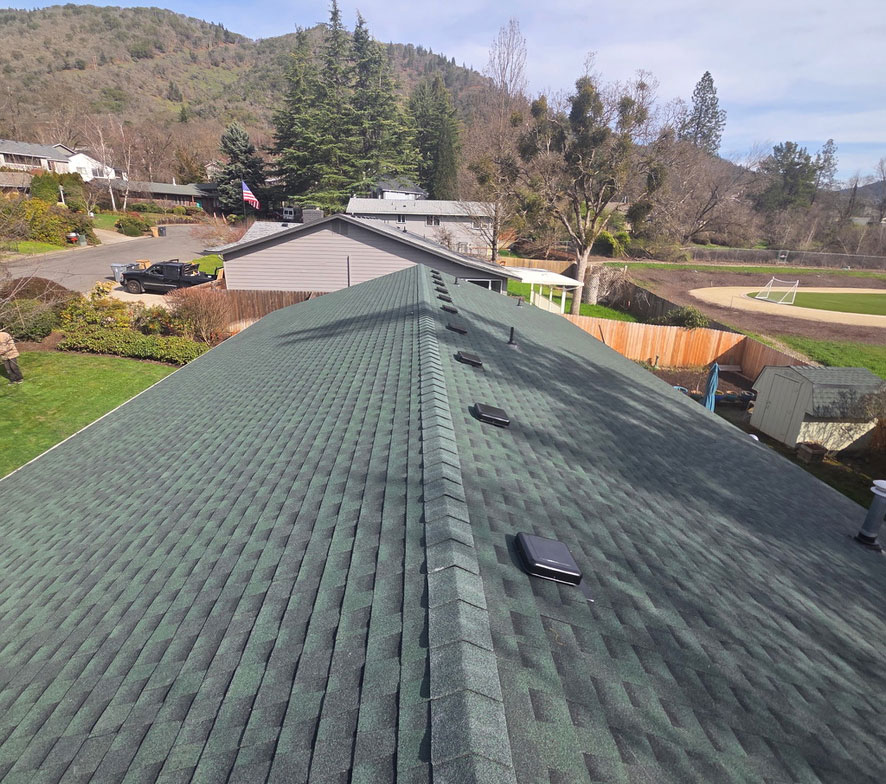
Many Rogue Valley homes built before the 1990s do not meet this standard. Soffit vents were often undersized, installed with insufficient air gap, or blocked by insulation pushed against the eaves during energy retrofits. Ridge vents were often absent entirely, replaced by individual box vents that provide exhaust area but do not create the continuous airflow that continuous ridge venting delivers.
Ridge Vent vs. Box Vent: Why the Type of Ventilation Matters
Continuous ridge vents run the full length of the roof ridge and exhaust warm air across the entire peak, matching perfectly with continuous soffit ventilation below. This creates a balanced, whole-roof ventilation system. Box vents, installed as individual units at isolated points on the roof, create partial exhaust that leaves significant portions of the attic with limited air movement. In Southern Oregon’s peak summer conditions, the difference between adequate and inadequate ventilation can be 20 to 30 degrees of attic temperature, which translates directly to years of shingle service life.
Ready for a free ventilation and roofing assessment in Southern Oregon?
HOMEMASTERS Southern Oregon serves Medford, Ashland, Grants Pass, Jacksonville, Central Point, Talent, Phoenix, Eagle Point, Applegate, Shady Cove, Gold Hill, Rogue River, and Cave Junction. Call (541) 240-8977 or visit homemasters.com.
Ventilation and Your Roof Replacement: Why Timing Together Saves Money
Addressing ventilation deficiencies is most cost-effective when done during a roof replacement project. When the roof deck is already exposed after tear-off, installing continuous ridge venting involves cutting the ridge opening and installing the vent product in conditions where the surrounding roofing system is already staged. The incremental labor cost is a fraction of what a standalone ventilation project would require.
Conversely, a homeowner who replaces their roof without addressing known ventilation deficiencies is installing a new shingle system over a heat accumulation problem that will shorten the new roof’s service life before it reaches its stated warranty potential. HOMEMASTERS Southern Oregon evaluates ventilation as a standard component of every roofing project assessment and presents ventilation findings and recommendations with every estimate. Schedule your HOMEMASTERS roofing assessment here.
Frequently Asked Questions: Roof Ventilation in Southern Oregon
In Southern Oregon’s summer climate, inadequate attic ventilation allows heat to build to 150 to 180 degrees Fahrenheit in the attic space. This superheated air cooks the shingles from below, accelerating granule loss, oxidation, and cracking significantly faster than UV exposure alone causes. Call HOMEMASTERS Southern Oregon at (541) 240-8977.
Key signs include shingles aging faster than expected, unusually high summer cooling costs, a hot attic that stays warm well into evening, frost or moisture on attic surfaces in winter, and ridge or soffit vents that are blocked or absent. Call HOMEMASTERS Southern Oregon at (541) 240-8977 for a ventilation assessment.
The International Building Code requires a minimum of 1 square foot of net free ventilation area per 150 square feet of attic floor space, split evenly between soffit intake and ridge exhaust. In Southern Oregon’s hot summers, many roofing professionals recommend exceeding this minimum. Call HOMEMASTERS Southern Oregon at (541) 240-8977.
Not always. Ventilation improvements can often be addressed as targeted work on an existing system. However, if the roofing system is near end of life, addressing ventilation during replacement is the most cost-effective approach. Call HOMEMASTERS Southern Oregon at (541) 240-8977.
Yes. Every HOMEMASTERS Southern Oregon roofing inspection includes a ventilation assessment covering intake and exhaust vent count and condition, net free ventilation area calculation, and identification of any blockages or deficiencies. Call (541) 240-8977 to schedule your free inspection.
This Month: Get $1,000 Off and Free Gutters With Your Roof Replacement Call HOMEMASTERS Southern Oregon at (541) 240-8977 or visit homemasters.com to claim this offer.