Key Takeaways
A Rogue Valley summer damages roofs through ultraviolet exposure and heat rather than through water, and the evidence looks nothing like the water damage most inspection advice describes.
Ember exposure does not require a fire nearby. Debris in a valley or a gutter is the ignition risk, and it accumulates fastest in the weeks after fire season.
South and west facing slopes age visibly faster here than north facing ones, which is the opposite of the pattern west of the Cascades.
September is the pivot point of the year for a Southern Oregon roof: fire season is closing and the wet season has not started, which makes it the only comfortable window for both inspection and work.
HOMEMASTERS Southern Oregon serves Ashland, Talent, Phoenix, Jacksonville and Central Point. Free written estimates. Call (541) 240-8977.
Book an inspection with HOMEMASTERS Southern Oregon Oregon CCB licensed, bonded and insured, Owens Corning Platinum Preferred and GAF certified, with W-2 employee crews rather than subcontractors. Call (541) 240-8977.
Most roof inspection advice you will find online was written for a wet climate. It tells you to look for moss, for water staining, for the slow damage that a temperate maritime winter does. Ashland sits on the other side of the Cascades, and the damage that matters here happens between June and September while nothing appears to be going wrong at all.
By late summer a Rogue Valley roof has absorbed several months of intense ultraviolet exposure and repeated days above one hundred degrees, and it has collected whatever the surrounding conifers dropped. Both of those matter, and both are visible now.
What should an Ashland roof inspection look for after summer?
Check the south and west facing slopes first for granule loss, shingle curling and brittleness at the edges, then clear and examine every valley and gutter for needle and leaf debris, then look at all flashing and vent penetrations for sealant that has cracked in the heat, and finally check attic ventilation. Ultraviolet degradation, heat cycling and combustible debris are the three specific things a Southern Oregon summer leaves behind.
The four things a Rogue Valley summer does
1. Ultraviolet exposure strips granules
The mineral granules on an asphalt shingle are its ultraviolet shield. Under Rogue Valley sun they wear away fastest on south and west facing planes, and once the asphalt beneath is exposed it hardens, loses flexibility and begins to crack. Look at the base of your downspouts. A meaningful accumulation of granules on a roof past fifteen years is a real signal rather than a cosmetic one.
2. Heat degrades the roof from underneath
Attic temperatures on a hot Ashland afternoon can run far above outside air temperature, and that heat cooks the shingle from the back face while the sun works on the front. A poorly ventilated attic effectively ages a roof twice. This is why ridge and soffit ventilation is not a winter concern in this climate. It is a summer one.
3. Thermal cycling opens sealed joints
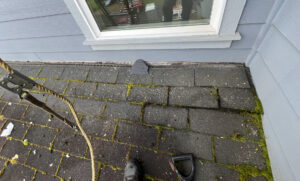
The daily swing between a hot afternoon and a cool night expands and contracts every metal component on the roof. Over a season that movement works on counter flashing sealant, on the rubber boots at plumbing vents and on exposed fastener heads. Cracked vent boots are one of the most common and least expensive causes of a winter leak, and they are easy to see in September.
4. Debris accumulates in exactly the wrong places
Pine and fir needles collect in valleys, behind chimneys, along the low edge of dormers and in gutter runs. That matters for two reasons. Wet debris holds moisture against the roof surface through the coming wet season, and dry debris is fuel. In the wildland urban interface around Ashland and the Siskiyou foothills, the realistic ignition scenario is not a wall of flame. It is a wind carried ember landing in a gutter full of dry needles.
Want a written findings list before the first storms? Call HOMEMASTERS Southern Oregon at (541) 240-8977 for a free written estimate with no pressure and no obligation. See service details on the Southern Oregon location page.
Ember resistance, in plain terms
Ember defence is a set of small details rather than one product. A Class A fire rated roof assembly is the baseline, and most modern asphalt shingle systems achieve it as an assembly rather than as a shingle alone, which is why installation matters as much as the product. Beyond that, the details that matter are keeping valleys and gutters clear, closing gaps at the ridge and at eave edges where embers can lodge under a course, using ember resistant venting rather than open vents, and maintaining the ground immediately around the house.
Class 4 impact resistant shingles are worth pricing for hillside properties here, and in many Oregon policies they qualify for an insurance discount, though that varies by carrier and you should confirm it with yours rather than assume it.
Clear gutters are the single highest value maintenance item on a wildland interface property, and gutter guards are worth considering where conifer litter is constant.
What replacement costs, if it comes to that
A full residential roof replacement in this service area runs $9,500 to $22,000, and a standard 2,000 square foot home with 50 year architectural shingles usually falls between $12,000 and $16,000. Steep hillside lots, complex geometry and difficult access push a project toward the upper end. Actual cost depends on home size, pitch complexity, material tier and decking condition, so a free written estimate is the only reliable figure. If solar panels are already installed, budget $3,000 to $6,000 for removal and reinstallation.
Most September inspections in this area do not produce a replacement recommendation. They produce a short maintenance list, which is the entire point of looking early.
Frequently Asked Questions
What should I check on my Ashland roof after fire season?
Start with the south and west facing slopes, looking for granule loss, curling and brittle edges, then clear and inspect every valley and gutter for needle debris, then check all flashing and vent boots for heat cracked sealant, then look at attic ventilation. Ultraviolet damage, thermal cycling and combustible debris are what a Rogue Valley summer leaves behind. Call HOMEMASTERS Southern Oregon at (541) 240-8977 for a written assessment.
Why does my south facing roof slope look worse than the north side?
Because ultraviolet exposure, not moisture, is the dominant ageing mechanism in the Rogue Valley. South and west facing planes take the most direct sun and lose granules fastest, then harden and crack. West of the Cascades the pattern reverses, because there the north facing slopes stay damp and grow moss.
Do gutter guards help with wildfire risk?
They help by keeping dry conifer litter out of the gutter, which is a realistic ignition point when wind carried embers arrive. They are not a fire protection product on their own and they do not remove the need to clear debris from valleys and roof surfaces. Treat them as one part of a maintenance routine.
Are impact resistant shingles worth it in Southern Oregon?
They are worth pricing, particularly on exposed hillside properties. Class 4 impact resistant products offer better resistance to hail and debris impact, and many Oregon insurance policies offer a discount for them, though this varies by carrier. Confirm the discount with your own insurer before treating it as part of the value.
When is the best time for roof work in Ashland?
September and October. Fire season is closing, the wet season has not begun, and shingle sealant strips bond by solar heat, so warm dry installation produces a stronger initial seal. Booking now also puts your project ahead of the first storm calls. Call (541) 240-8977 to check current scheduling.
Get a free written roof assessment in Ashland HOMEMASTERS Southern Oregon provides free written estimates with no obligation across Ashland, Talent, Phoenix, Jacksonville and Central Point. Call (541) 240-8977 or visit the Southern Oregon location page to request a visit.